ServicesWater testing
Grapevine Water Testing
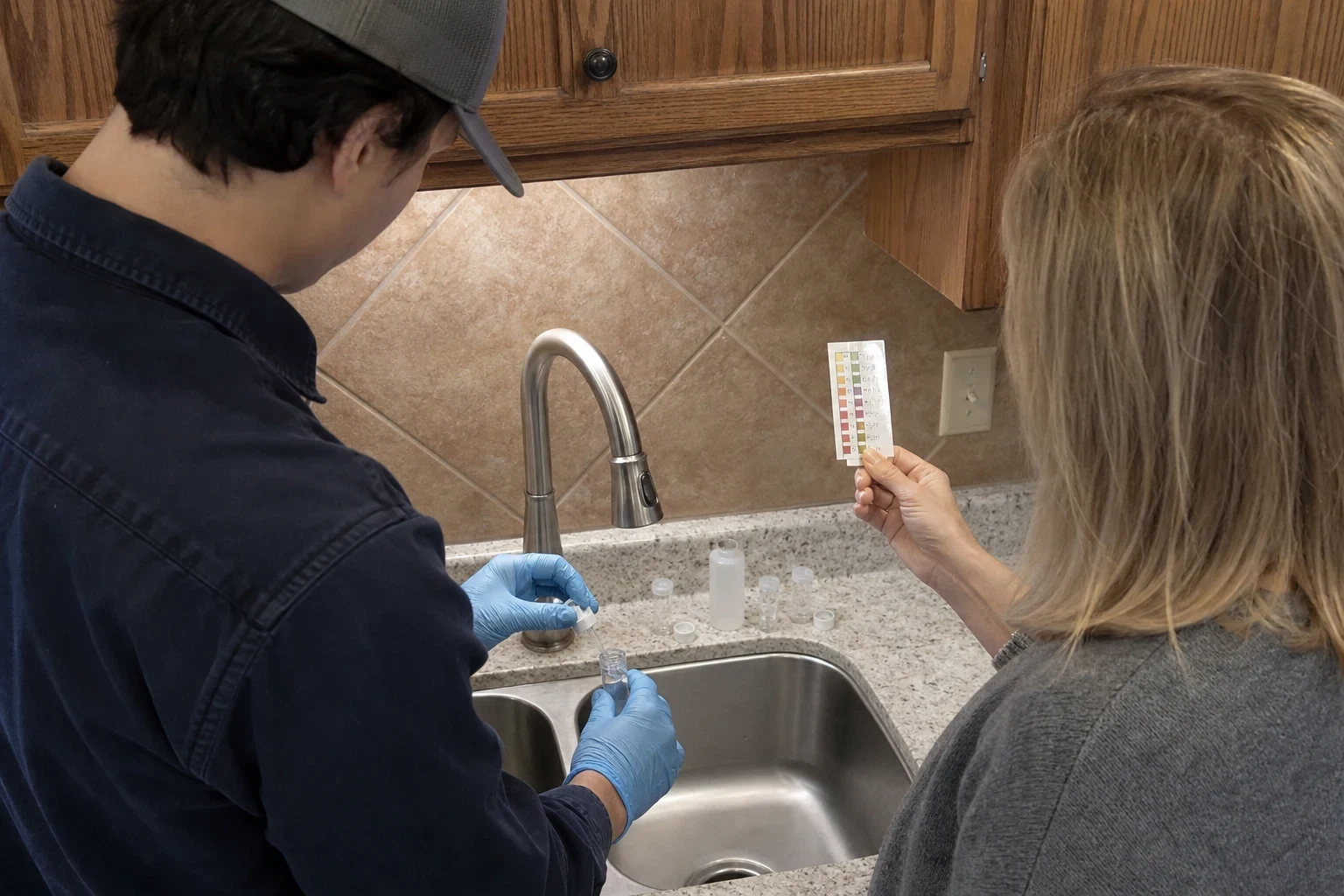
Before anyone mentions equipment, you get actual readings from your own faucet. We take samples, explain each result in everyday terms and tell you honestly whether treatment would help, so you don't pay for a system that solves nothing.
Why we start with a test
Most water problems show up as a taste, a smell, a stain or a crusty faucet. Those clues point in different directions. Chlorine taste calls for carbon. Orange stains point to iron. White scale on fixtures is usually hardness. Guessing wrong means paying for equipment that runs, uses water and needs filters without fixing what bothers you.
A test also protects your running costs. Scale coats the inside of a water heater and slows how fast heat reaches the water, so the heater works longer for the same hot shower. Knowing your actual hardness tells you whether that is happening in your home, or whether a softener would just add salt and regeneration water you don't need.
If your water comes back clean and balanced, we will tell you that. Some homes need nothing more than a simple drinking water filter, and some need nothing at all.
What we check in your water
Hardness level
Calcium and magnesium are the minerals that leave scale behind. Measuring them shows whether your water heater, dishwasher and fixtures are actually at risk.
Iron and sediment check
Iron stains sinks and laundry, and sediment wears out valves and filters early. We check both at the tap.
Chlorine level
City water is disinfected on purpose. We measure how much reaches your faucet, which tells us whether carbon filtration would improve taste and smell.
pH and dissolved solids
These two numbers help explain cloudy water, odd taste and spotting on glassware, and they guide which equipment will work well.
Lab testing when it matters
For lead from older plumbing, private wells or anything we can't measure accurately on site, we collect a sample for an independent lab and walk you through the report when it comes back.
A written summary
You get your numbers in writing with a short note on what each one means and what, if anything, we would recommend.
When a water test makes sense
- A new taste or odor
- Water that smells like a swimming pool, tastes metallic or seems musty deserves a check before you start hauling home cases of bottled water.
- White crust on faucets and showerheads
- Scale buildup suggests hardness. A test confirms how much, which tells us if it is quietly costing you water heater efficiency.
- A rusty tint that keeps coming back
- When the toilet bowl, the tub or your white towels keep picking up a reddish cast, the cause is often iron in the water or pipes that are starting to corrode. Each has a different fix, so it pays to know which one you have.
- Older plumbing
- If your home has original pipes or older solder joints, a lead test gives you a clear answer for the water your family drinks and cooks with.
- You're shopping for a filter
- Testing first keeps you from buying a system sized for the wrong problem.
How a test visit works
- 1
A short phone conversation
You tell us what you're noticing and how old your home and plumbing are. That helps us decide which tests make sense so you're not paying for ones you don't need.
- 2
Samples from a few fixtures
The kitchen faucet is our main sample point, plus one more fixture, and the water heater drain when scale is the worry. The visit takes well under an hour, and nothing is left out of place.
- 3
Results and a straight answer
On-site readings are explained before we leave. Lab results follow by phone once the report is in, and we go over each number with you.
- 4
Options, only if needed
If treatment makes sense, we explain the one or two choices that fit, such as whole-house carbon filtration or an under-sink reverse osmosis system, and what each costs to run.
What affects the cost of water testing
Pricing depends on how much testing your water actually needs. A quick check for chlorine and hardness is a smaller job than a full lab panel. We go over the options by phone so you know what you're paying for before we arrive.
- On-site versus lab tests
- Readings we take at your tap cost less than samples sent to an outside lab, which charges for each contaminant it analyzes.
- Number of contaminants
- Testing for one or two concerns is simpler than a broad panel covering metals and other trace items.
- City water or private well
- Wells aren't covered by any utility report, so they usually call for a wider set of tests.
- Sample points
- Testing several taps or the water heater adds a little time, and it can pinpoint whether a problem comes from your plumbing or the supply.
Water testing questions
- My city already tests the water. Why would I test mine?
- The city tests water at the treatment plant and across its system, and it publishes an annual report you can read. What it can't see is what happens inside your own pipes, fixtures and water heater. Lead from older plumbing and iron from corroding lines start after the meter, so a test at your tap fills that gap.
- Are you going to push me toward a softener?
- No. We only suggest a softener when your hardness numbers support one. If your water is soft enough, we'll say so and point you to something smaller or nothing at all.
- How long until I have results?
- Most on-site readings are ready during the visit. Lab samples take longer, and we call you to walk through the report once it arrives.
- Can testing really affect my energy bills?
- It can, indirectly. Heavy scale insulates the heating surfaces in a water heater, so it burns more energy for the same hot water. A hardness test tells you if that's a real issue in your home before you spend anything to fix it.
- Does someone have to be home during the visit?
- Yes. We need to reach your faucets, and being there lets you ask questions as we work. The visit is short. Point out any sink or shower where you've seen stains, scale or an odd taste, and we'll sample there too.
Find out what's in your water
A test gives you real numbers and an honest answer about whether you need treatment. We serve Grapevine and nearby towns like Southlake, Colleyville and Euless.